The recent announcement that the UK Space Agency will be absorbed into its parent department, the Department for Science, Innovation and Technology (DSIT), has triggered headlines suggesting the end of Britain’s space ambitions. That is overstated. The change is real, but it is primarily a restructuring. UKSA will lose its status as an executive agency and instead become a directorate within DSIT. Its programmes and teams will continue, but its independence, visibility, and ability to speak with authority will be diminished.
To understand the implications, it helps to step back and look at how the UK government is organised. Space policy sits within a complex Whitehall system of departments, agencies, and regulators, each with distinct responsibilities. Misreporting often comes from treating all of these as “the government” without recognising the hierarchy or the difference between setting policy and delivering programmes.
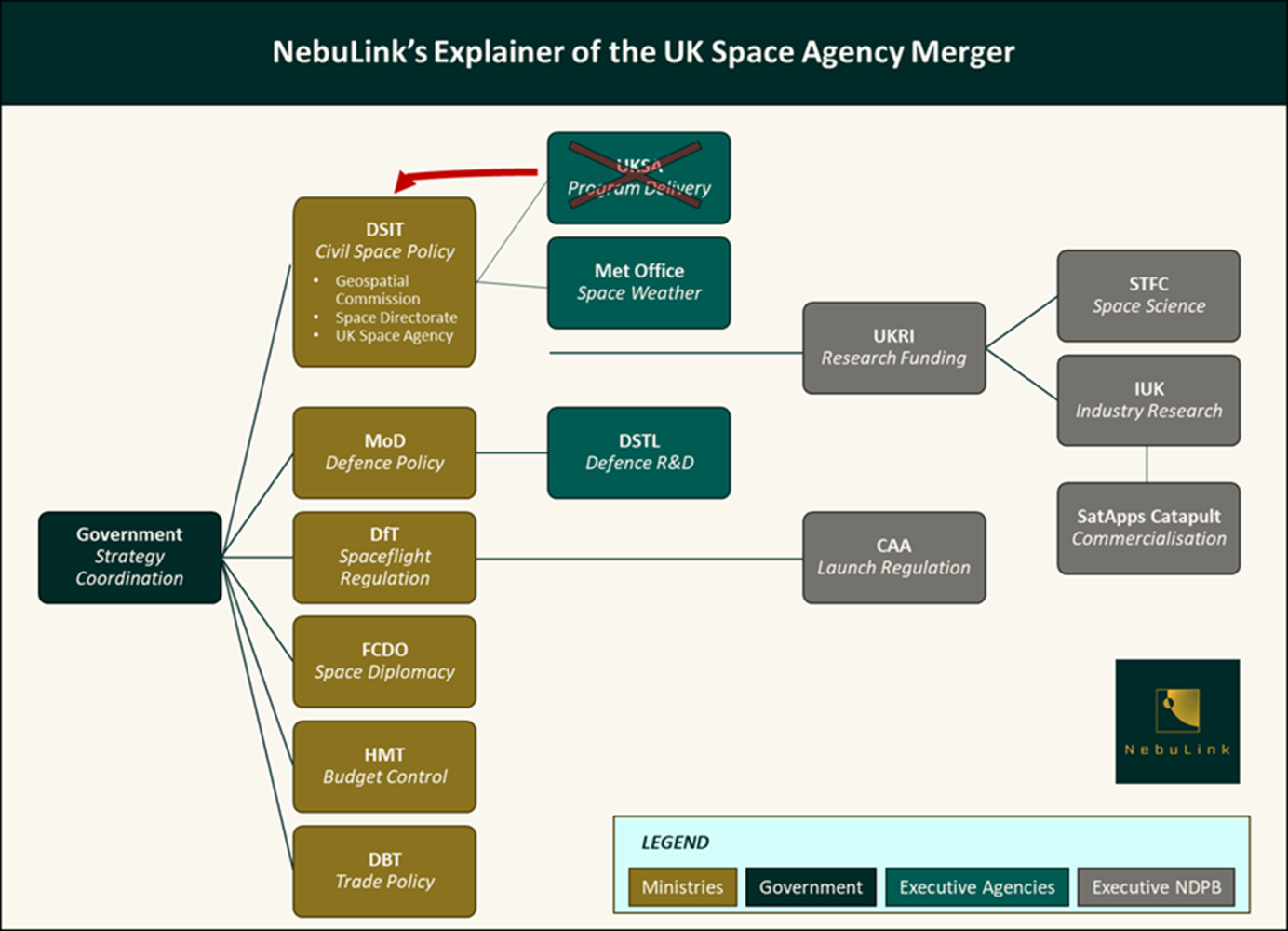
To begin, what is meant by the government in the UK?
In the UK, the general public has the tendency to call everything from the police to the Prime Minister ‘the government’. This is, strictly speaking, incorrect. When discussing government body restructuring, it is important to understand exactly what is being talked about.
The government is the executive branch of the state, similar in role to the President of the United States and their Cabinet. It is the body responsible for running the country, developing policy, and drafting laws. Today, this is led by Sir Keir Starmer, the Prime Minister, who has appointed 29 Cabinet Ministers to his government.
Not every minister heads a department. Some Cabinet Ministers do—for example, the Secretary of State for Defence runs the Ministry of Defence. Others hold cross-cutting or portfolio roles without their own department, such as the Chancellor of the Duchy of Lancaster, who sits in the Cabinet Office to coordinate government policy, or the Minister without Portfolio, who focuses on political and party matters.
For space, this top layer matters because it decides whether space is treated as a strategic national priority. The Cabinet Office plays a central role here. It supports the Prime Minister, ensures policy is joined up across Whitehall, and manages the system of Cabinet Committees that make decisions on specific issues.
One such committee was the National Space Council, created in 2020 to coordinate the UK’s civil and defence space policy. Chaired at Cabinet level and supported by the Cabinet Office, its purpose was to align the work of departments such as DSIT, the Department for Business and Trade, and FCDO Services under a unified space strategy. Although it is now largely dormant, its creation demonstrated that space was considered important enough to require attention at the highest political level, on par with national security and economic policy.
Ministerial Departments
Beneath the Prime Minister and Cabinet sit the ministerial departments. These are the core Whitehall organisations that turn political direction into policy and manage the government machine. Each is led by a Secretary of State and staffed by politically neutral civil servants.
For space, six departments matter:
- Department for Science, Innovation and Technology (DSIT): The lead civil space department. It contains the Space Directorate, the policy unit responsible for setting national space strategy. DSIT also houses the Geospatial Commission, which coordinates the use of geospatial data across government.
- Ministry of Defence (MoD): Home to the Defence Space Directorate, which shapes military space policy and ensures it is integrated into wider national defence and security planning.
- Department for Transport (DfT): Its Aviation, Maritime and Security Group covers spaceflight policy, including the framework for launches and spaceports.
- Foreign, Commonwealth and Development Office (FCDO): Contains a Space and Advanced Technologies team, which leads UK engagement in space diplomacy, international treaties, and forums such as the United Nations Committee on the Peaceful Uses of Outer Space.
- Department for Business and Trade (DBT): Maintains policy teams dedicated to trade and investment in the space sector, promoting UK capabilities abroad and encouraging inward investment.
- HM Treasury: Does not have a dedicated space unit, but its spending and infrastructure teams control the flow of funding into space, from European Space Agency subscriptions to national satellite projects.
Together, these departments and their internal policy units form the policy backbone for UK space. They decide strategy, coordinate across government, and determine the financial framework that underpins delivery.
Executive Agencies: the delivery arms of departments
Departments set policy, but they do not always deliver programmes themselves. Instead, they often rely on executive agencies—specialist units that are part of the civil service but operate at arm’s length. Each has a chief executive who runs the organisation, while a minister remains accountable to Parliament for its performance.
For space, the key executive agencies are:
- UK Space Agency (DSIT): The government’s civil space delivery arm. It turns national space strategy into practice, manages the UK’s contributions to international programmes such as the European Space Agency, and runs national funding schemes for science and industry.
- Met Office (DSIT): Best known for weather forecasts, but also a crucial provider of space weather services. It monitors solar storms and provides warnings that protect satellites, power grids, and aviation systems.
- Defence Science and Technology Laboratory (Dstl, MoD): The MoD’s in-house research agency. While it covers the full range of defence science, it has a significant space element, including work on sensors, secure communications, and counter-space resilience.
These agencies show how government policy moves from Whitehall strategies into real-world activity: funding missions, providing warnings, and developing technologies. They are the bridge between departments and the frontline of delivery.
Executive NDPBs: independent regulators and funders
Executive agencies sit inside the civil service, but some functions are considered too sensitive or too specialised to be run directly by ministers. In these cases, government creates Executive Non-Departmental Public Bodies (NDPBs). These are legally separate organisations, with their own boards and chief executives. Ministers set the policy framework and provide funding, but cannot interfere in their day-to-day decisions.
For space, the most important Executive NDPBs are:
- Civil Aviation Authority (CAA, DfT): The UK’s independent aviation and spaceflight regulator. Since 2021, the CAA has been responsible for issuing launch licences, overseeing spaceports, and regulating orbital operations under the Space Industry Act.
- UK Research and Innovation (DSIT): The UK’s main research funding body. It supports space science and technology through its research councils, including the Science and Technology Facilities Council (STFC) and Innovate UK, which focus on major facilities, research funding, and industry innovation.
- Satellite Applications Catapult (via Innovate UK, within UKRI, under DSIT): Part of a network of “Catapults” created to accelerate innovation. It helps businesses and researchers turn satellite data into commercial services, from agriculture to telecommunications.
These organisations illustrate a different model of governance. While still funded by government, they are designed to make decisions independently, whether that means regulating launch safety, awarding research grants, or supporting commercialisation.
Public Corporations: government-owned but commercial
Some government bodies are expected to operate much more like companies. These are called Public Corporations. They are government-owned, but unlike agencies or NDPBs they generate most of their income from commercial sales rather than direct grant funding. They still serve a public role, but their business model is closer to the private sector.
In the space and geospatial field, the main example is:
- Ordnance Survey (OS, DSIT): The UK’s national mapping agency. While it has a public duty to maintain accurate national maps, most of its income comes from selling geospatial data and digital services. OS makes heavy use of satellite imagery and Earth observation data in its work, making it directly relevant to the wider space sector.
Public Corporations like OS show a different side of government involvement: they are publicly owned but commercially driven, sitting at the intersection of the state and the market.
Quangos, ALBs, and the jargon
The term quango (quasi-autonomous non-governmental organisation) is old political slang for bodies that are government-funded but operate at arm’s length. It isn’t an official category.
Today the proper term is Arm’s-Length Body (ALB). This is the umbrella for:
- Executive Agencies (inside the civil service, semi-autonomous),
- Executive NDPBs (independent legal bodies with boards), and
- Public Corporations (government-owned but commercial).
In short: every “quango” is an ALB, but not every ALB looks the same.
So what is happening to the UK Space Agency?
The UK Space Agency is currently an Executive Agency of DSIT, which means it sits inside the civil service, with a chief executive and its own identity, while formally remaining part of the department. The government has now announced that, as part of a cost-cutting and streamlining exercise, the Agency will be folded directly into DSIT. In practice, this means it will cease to be an Executive Agency and instead become a policy and delivery unit within the department itself.
Should you be worried?
The announcement has generated alarmist headlines, but the reality is more mixed. The most important point is that the UK Space Agency’s core functions do not disappear. It will still manage Britain’s subscriptions to the European Space Agency, oversee national funding schemes, and coordinate civil space policy. The same teams will continue their work, only now as part of DSIT rather than as a stand-alone agency.
What does change is the status of the organisation. The Agency will lose its position as a separate executive agency, along with its chief executive, and instead become a directorate inside the department. That means it will no longer speak with the same institutional identity as bodies such as the Met Office or DVLA, but rather as one of several units inside DSIT. Its visibility and brand will inevitably be weaker, and it will have less day-to-day autonomy when it comes to technical or programmatic decisions.
We’ve actually already seen similar changes before. A few years back, the former science department, BEIS, decided to revoke the UK Space Agency’s space policy responsibilities and instead leave it more of a delivery agency. Although perhaps a more apt example is the Geospatial Commission. When it was created in 2018, it sat in the Cabinet Office with its own commissioners, a dedicated secretariat, and a high profile across government. Its job was to set national geospatial strategy and coordinate the “Geo6” bodies such as Ordnance Survey and the UK Hydrographic Office. Over time, however, that independence was eroded. First it was treated more like a standard policy unit within the Cabinet Office, and later it was absorbed into the Government Digital Service and now into DSIT. What began as a semi-autonomous, flagship initiative is today just another directorate inside a department—a trajectory the UK Space Agency now appears to be following.
The risk is that space becomes a lower priority, competing for political attention alongside DSIT’s wider responsibilities for digital policy, AI, and technology regulation. Internationally, the UK may look less prominent compared to countries with strong, independent agencies like CNES in France or DLR in Germany.
Yet there is also an upside: folding the Agency into DSIT may reduce administrative costs and bring space policy closer to the heart of government’s wider science and technology strategy, which has been a stated ambition for several years.
One potential benefit of folding the Space Agency into DSIT is a reduction in duplication. At present, space policy and funding roles are scattered across a patchwork of organisations: the Agency itself, DSIT’s Space Directorate, UKRI, STFC, and the Satellite Applications Catapult all recruit people to do strikingly similar work.
From my own experience applying to positions across these bodies, I have seen near-identical job descriptions repeated under different banners. Consolidation could streamline this system, cut administrative overhead, and make responsibilities clearer, though whether that efficiency gain outweighs the loss of visibility remains to be seen.
What does everyone else do?
Most major space powers maintain strong, independent agencies. NASA in the US, CNES in France, and DLR in Germany all operate with their own leadership, budgets, and brand identity, giving them political weight at home and credibility abroad. By contrast, the UK’s plan to fold the Space Agency into DSIT aligns it more with countries such as Australia and New Zealand, where “space agencies” function as departmental units rather than stand-alone bodies. This approach is not unique, but it places Britain closer to mid-tier models that prioritise administrative efficiency over visibility, rather than the big-agency structures that dominate international space cooperation.
Conclusion
In short, this is not the abolition of UKSA. The UK will still have a civil space programme. But with the Space Agency folded into Whitehall machinery, Britain risks being seen less as a space power in its own right and more as a mid-tier player managing space alongside digital policy and AI. Whether that trade-off is worth it will only become clear over time.