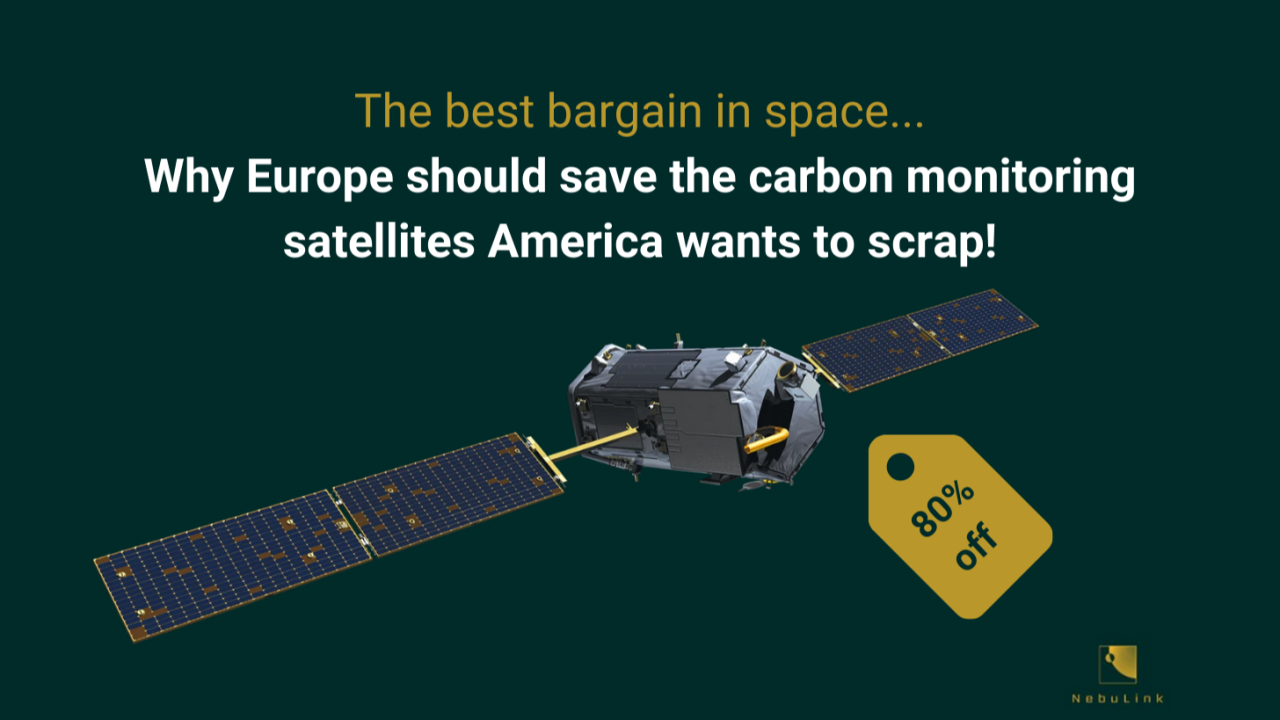
The best bargain in space may be about to go up in smoke, for no real reason. President Trump’s FY2026 budget moves to shut down two fully operational carbon monitoring satellites that remain the most precise instruments of their kind. These satellites have been built, paid for, and are still generating critical data, yet they are slated for termination to save a mere few million dollars a year. Europe should step in and secure them.
America Walks Away
The Trump administration’s FY2026 budget proposal is blunt: OCO-2 and OCO-3 are to be switched off. NASA has been instructed to prepare decommissioning plans. For OCO-2, that means lowering its orbit until it burns up in the atmosphere; for OCO-3, simply powering down the instrument on the ISS. The justification is cost, but the numbers do not stand up to scrutiny. Annual operations are in the low tens of millions of dollars, barely noticeable within NASA’s budget and negligible compared to the billions already invested in Earth observation.
This is not a decision driven by technical obsolescence. Both platforms remain fully functional and scientifically valuable. It is, instead, a political choice: a visible cut that signals disengagement from climate monitoring. The House of Representatives has backed the move; the Senate wants to maintain funding. If the House line prevails, the shutdown could be executed within weeks of the budget passing.
For Europe, this is the pivotal moment. What Washington discards for symbolic savings could be preserved at trivial cost, even transformed into a strategic advantage.
The Cost of Doing Nothing
If Europe stands aside, the consequences will be immediate:
- Broken Data Chains: A decade-long, calibration-consistent dataset will be broken, and that break cannot be repaired later. Treaty verification under the Paris Agreement will lose credibility.
- Market Destabilization: Without continuous measurement, it becomes far easier for governments to manipulate reporting or delay action. The impact would ripple into markets. Carbon pricing schemes and offset verification rely on independent atmospheric checks. Without OCO data, disputes multiply, trust weakens, and the value of carbon markets erodes.
- Downstream Volatility: Agriculture would feel it too. Crop forecasting models integrate OCO’s photosynthesis data to predict yields. Strip that out and accuracy drops, exposing insurers, commodity traders, and farmers to greater risk.
“The satellites cost little to run. But the costs of losing them, in credibility, in commercial disruption, in lost scientific continuity, are orders of magnitude higher. Doing nothing is not just passive, it is actively expensive.”
Europe’s Gap to Fill
Europe has built one of the strongest civilian Earth Observation fleets in the world, yet it does not currently have a public system to match OCO’s precision and coverage. Sentinel-5P’s TROPOMI can measure CO₂, but at a much coarser scale. Commercial players like GHGSat can deliver pinpoint methane and CO₂ detection at facility level, but they do not provide the global, open-access record OCO delivers.
The gap will close eventually. France’s MicroCarb launched this year, but as a single satellite its coverage will be limited. ESA’s flagship CO₂M constellation promises world-class capability, but first launches are not expected until 2026/2027 and validation will take time. In practice, that leaves Europe with at least a two- to three-year window without sovereign access to an OCO-class dataset.
Filling that gap is a strategic necessity. The cheapest, fastest way to do it is to take over operations of OCO-2 and OCO-3. These satellites are not Europe’s yet, but they could be, and for a price that is almost laughably small compared to the value they deliver.
A Deal on the Table
Europe does not need to reinvent the wheel. OCO-2 and OCO-3 are already in orbit, fully functional, and producing unmatched carbon data. What they lack is a backer. The annual operations bill sits in the low tens of millions of dollars, modest by space standards, and insignificant compared to the sums already committed to Copernicus.
This is where a deal becomes possible. Washington wants to cut the line item. Europe needs to fill a gap. If ESA or the European Commission steps in, the satellites keep flying, and both sides can declare success. For the US, the politics are straightforward. The budget cut is achieved, and the story becomes one of allies “paying their share.” For Europe, the payoff is continuity of the gold-standard CO₂ dataset, leverage in climate diplomacy, and a stronger hand as MicroCarb and CO₂M come online.
Structurally, the options are simple. Europe could assume the full cost through ESA. A cost-share arrangement is equally feasible, with both sides contributing while Europe secures guaranteed access and a role in setting priorities. Hybrid models could involve philanthropic or commercial co-funding. However it is structured, the mechanism is clear. A small operational outlay preserves a globally critical dataset and allows both Washington and Brussels to claim a win.
The Financial Metrics
What makes this opportunity remarkable is the value-for-money. Running OCO-2 and OCO-3 for another three to five years would cost Europe less than one percent of what it is already spending on new satellites. For a fraction of a single Copernicus mission, Europe could buy immediate access to the sharpest CO₂ dataset ever collected.
| Asset & Program Cost Center | Total Sunk Capital | Historical Operations Baseline | Proposed Bridge Allocation | Net Strategic Value |
|---|---|---|---|---|
| OCO-2 Baseline (Build & Launch) | $465,000,000 | $10,000,000 / yr | — | — |
| OCO-3 Baseline (ISS Integration) | $250,000,000 | — | — | — |
| Combined Fleet (10-Year Lifecycle) | $700,000,000 | $70,000,000 / yr | $15,000,000 / yr | 79% Discount |
I ran the numbers, conservatively. OCO-2 cost about $465M to build, launch, and for ground systems, with an addition $10M in operating costs per year. Over ten years this is at least $550M. For OCO-3, it likely cost half that at $250M as it is mounted on the ISS. This means, over a ten year timeframe, the total cost to NASA has been about $700M, or $70M a year. As the system is set to be scrapped, if Europe instead stepped in and provided $15M per year to operate both, that would represent a 79% discount compared to building one ourselves.
The return is outsized. These satellites bridge the two- to three-year gap before MicroCarb and CO₂M are operational, ensuring Europe avoids a break in continuity that would undermine treaty verification and commercial applications alike. They also provide the calibration reference that will make Europe’s own future missions more credible from day one.
No other move in space policy offers such a high ratio of strategic gain to financial cost. For policymakers in Brussels or London, this is the definition of a bargain. Minimal spend, maximum leverage, and an instant upgrade to Europe’s role as the custodian of global carbon data.
We’ve Done This Before
This kind of arrangement is not new. Space agencies have a long history of extending the life of valuable missions through shared funding and operations. Hubble stayed productive for decades thanks to joint NASA–ESA servicing. NOAA and EUMETSAT run weather satellites under a burden-sharing agreement, each partner covering part of the constellation while sharing the data. ESA scientists already rely on ICESat-2, a US satellite, for polar monitoring under international cooperation agreements.
The lesson is simple. When a capability is too valuable to lose, allies step in. OCO-2 and OCO-3 are no different. The instruments are working, the data is irreplaceable, and the cost of preserving them is trivial compared to building a new system. Europe stepping in would not be a radical departure. It would be a continuation of a proven model, pooling resources to protect shared interests in space.
Europe’s Leadership Moment
Stepping in to save OCO-2 and OCO-3 is more than an act of pragmatism. It is a chance to set the tone for global climate leadership. Europe has already positioned itself as the centre of gravity for environmental monitoring through Copernicus and the European Green Deal. Taking over the world’s most precise CO₂ dataset would reinforce that role, sending a clear signal that when others retreat, Europe advances.
The payoff would extend beyond science. Climate diplomacy is a contest of credibility, and the side that controls the definitive dataset shapes the agenda. With OCO-2 and OCO-3 under European stewardship, Brussels would hold the evidence base that underpins treaty verification and market trust. London, Paris, Berlin, and Brussels would be the arbiters of whether national pledges align with atmospheric reality.
This is not only about filling a gap. It is about seizing the mantle of leadership. What Washington views as expendable, Europe can elevate into a defining capability, turning symbolic US cuts into a European strategic advantage.
Bridging to CO₂M
Europe is not short of ambition. MicroCarb is already in orbit, and the Copernicus CO₂M constellation is moving toward launch later this decade. Together they will give Europe sovereign, world-class carbon monitoring capability. But those systems are still commissioning or in development, and their early years will be defined by calibration and validation.
This is where OCO-2 and OCO-3 add unique value. Their decade of continuous measurements provides the baseline against which new European instruments can be cross-calibrated. If Europe funds them through to CO₂M’s entry into service, the continent secures an unbroken data chain from 2014 onwards, a dataset no one else can match. That continuity would strengthen the credibility of MicroCarb and CO₂M from day one, easing adoption by policymakers, markets, and international climate frameworks.
“I have not worked directly on climate datasets, but I have spent years in policy and programme analysis across the space sector. One thing has always stood out. Without consistent data, everything else unravels. I have seen major programmes lose credibility because one dataset ended before the next began.”
Without overlap, you can never be sure whether two systems are telling the same story, and policymakers quickly lose confidence. That gap opens the door to doubt, delay, and debate, exactly what climate policy cannot afford. It is the same principle you see in economics, when the OECD changes a measure they run the old and new side by side. Without that overlap, you do not know whether the data changed or the measurement did.
Europe’s Move to Make
This is not complicated. Two satellites are working. They are producing the best carbon data in the world. The United States wants to trash them to save pocket change.
Europe can step in, and for the price of a rounding error secure the gold-standard CO₂ dataset, bridge its capability gap, and prove that it can lead when others walk away. No committee, no multi-year procurement cycle, no billion-euro budget needed. Just a small cheque and a political decision.
In every programme I have worked on, one truth has stood out. Break the dataset and you break the trust. Without overlap, Europe’s new missions launch into doubt. With OCO, the handover is seamless and the credibility unquestionable.
This is the best bargain in space. Washington will call it a cut. Europe can call it a win. The only question is whether Brussels and London are ready to take it.