Welcome to the second edition of the DOGE Tracker by NebuLink. Updates will remain infrequent, as the DOGE API has been slow to ingest new space-related data points despite the steady drumbeat of ongoing federal contract modifications.
Reading the Roadmap: Why Tracking Minor Cuts Matters
Back in March, when the inaugural DOGE Tracker edition went live, several readers reached out regarding a specific $21.1 million deletion:
$21.1M – Termination of scientific support services provided by Autonomic Integra, LLC to NASA’s Goddard Institute for Space Studies (GISS) in New York.
Many saw it for what it truly was: an early indicator of institutional pressure building against GISS. Now that mainstream public reporting has confirmed GISS is losing the lease on its historic New York facility, it is clear that these entries were not random administrative cleanups. They were a strategic roadmap.
If you had been tracking the raw data back then, the warning signs were already visible. It raises a critical question for the wider space industry: what other quiet cancellations are hiding the next major structural retreat?
New Claimed Savings: April Dataset Overview
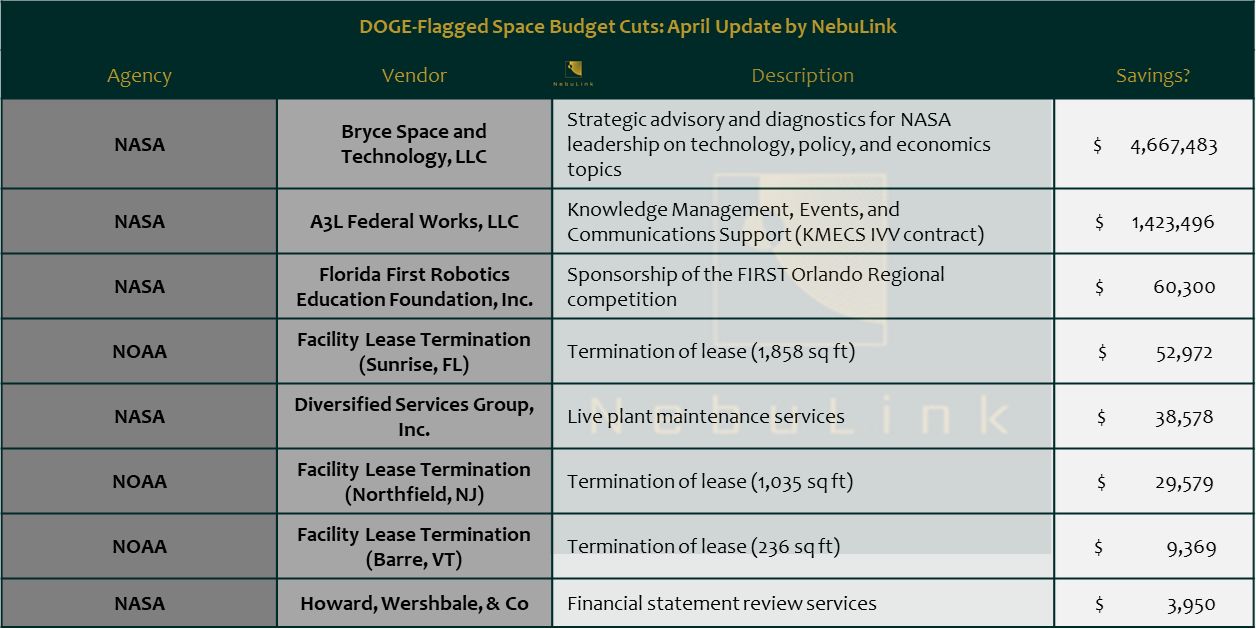
This month’s report covers the savings and terminations logged in the transparency database between 31 March and 28 April 2025. In total, the system claims $6,285,727 in realized savings across a narrow band of awards, operational contracts, and real estate leases.
Realized Capital Reductions: Grants & Strategic Contracts
The single largest capital reduction targeted Bryce Space and Technology, LLC, stripping away $4,667,483 in funding. Bryce was providing NASA leadership with independent market diagnostics, policy evaluation, and techno-economic advisory work. Given the contract’s vehicle structure, this represents a blanket agreement with a “potential value,” meaning much of the reported savings reflect a clawback of future services not yet executed.
The second-largest financial cut hit A3L Federal Works LLC, which lost $1,423,496. This contract had been designated for knowledge management, corporate communication architectures, and event integration support across NASA frameworks.
Minor operational and localized funding cuts include:
- Florida First Robotics Education Foundation Inc.: $60,300 removed from a regional robotics competition sponsorship.
- Diversified Services Group Incorporated: $38,578 cut from a live plant interior maintenance contract.
- Howard, Wershbale & Co: $3,950 cut from third-party financial statement review services.
Real Estate & Lease Terminations
The National Oceanic and Atmospheric Administration (NOAA) continued its physical footprint reduction, terminating several property leases:
- Sunrise, Florida: A facility utilized by the NOAA Fisheries Office of Law Enforcement.
- Northfield, New Jersey: A regional NOAA Fisheries facility.
- Barre, Vermont: An auxiliary NOAA facility.
While these terminations are explicitly framed as a space and footprint optimization strategy, asset-level details regarding relocation or personnel consolidation remain entirely opaque.
The Anomalous $0 Savings Trend: Cuts Without Cash
The most striking trend emerging from NebuLink’s latest audit is the sheer volume of high-value space, climate, and research contracts terminated for convenience where the recorded savings are exactly $0.
When a multi-million dollar program is wiped off the books with zero dollars clawed back, it points to a data environment where contract liquidations are being used to reshape agency agendas rather than balancing budgets.
1. The Erasure of Earth Science, Climate, and Environmental Justice Projects
A significant cluster of zero-dollar cancellations heavily targets academic programs utilizing space observations to map climate vulnerabilities and domestic environmental equity:
- Johns Hopkins University ($969,349 Contract • $0 Saved): A NASA-funded project focused on resolving intra-urban heat variability and local air quality from orbital and ground assets to support environmental justice applications.
- Virginia Tech ($763,904 Contract • $0 Saved): An interdisciplinary program aimed at democratizing Earth observation datasets for adaptation planning in the North-Atlantic Coastal Plain, tracking sea-level rise indicators like land subsidence and compound flooding.
- Brown University ($752,680 Contract • $0 Saved): A project utilizing NASA Earth observations to build resilient community planning frameworks around California’s Salton Sea.
- George Mason University ($529,129 Contract • $0 Saved): Wiped out an interdisciplinary Earth science program mapping socioeconomic disparities in health and safety impacts caused by domestic dust storms.
- Natural Areas Conservancy ($485,603 Contract • $0 Saved): Cancelled an urban space-data program assessing access to nature and environmental benefits across major US cities.
- Chenega Global Protection, LLC ($231,345 Contract • $0 Saved): Terminated the security police officer support contract designated for NASA’s public-facing Earth Information Center (EIC).
2. Squeezing Equity, Diversity, and Inclusion (EDIA) in Planetary Science
Academic workshops and systemic pipelines intended to diversify the incoming space workforce were systematically terminated across the board:
- Universities Space Research Association ($3,321,286 Contract • $0 Saved): Wiped out a massive planetary exploration and science engagement program under NASA’s Science Activation Portfolio (Science Mission Directorate).
- University of Alaska Fairbanks ($182,619 Contract • $0 Saved): Cancelled funding for a critical cross-analysis group working group meeting focusing on EDIA principles within the domestic planetary science community.
- National Society of Black Physicists ($99,751 Contract • $0 Saved): Terminated a dedicated Student Leadership Development Summit (SLDS) and technical workshops designed to advance minority student engagement in deep-space science.
- Cornell University ($260,000 Contract • $0 Saved): Cancelled an innovative leadership development and EDIA workshop tailored for executives within the planetary science ecosystem.
3. Deep Cuts to Advanced Technology Development & Autonomy
Beyond social and climate sciences, high-utility hardware and engineering portfolios were quietly dissolved:
- NUBURU®, Inc. ($849,989 Contract • $0 Saved): Wiped out a high-profile SBIR Phase II effort aimed at developing advanced blue laser technology for planetary surface and lunar power distribution networks.
- Unibap AB ($70,000 Contract • $0 Saved): Terminated the development phase of the OSE-SAT project, an orbital testbed built to validate in-space edge computing and satellite autonomy.
- UCAR ($14,000 Contract • $0 Saved): Terminated a line item tied directly to the DYNAMIC-X Phase A study, which investigates critical dynamical coupling between the Earth’s upper atmosphere and the ionosphere.
- R3 UNIQ Inc. ($71,649 Contract • $0 Saved): Cancelled core procurement licenses and infrastructure maintenance for the OMNeT network architecture simulation software tool.
Conclusion: What We Lose When We Call It “Savings”
The recurring occurrence of $0 entries for highly specialized, strategically vital programs completely upends the public narrative of fiscal optimization. These entries expose a process focused less on capital efficiency and more on actively dismantling specific research themes—specifically climate resilience, workforce equity, and early-stage lunar infrastructure.
At NebuLink, we believe that transparency is useless without contextual analysis. By monitoring these API updates row by row, our objective is to provide the space community with empirical visibility into what is being cut, who is losing out, and what long-term capability is being quietly traded away.
We will publish our next tracker update as soon as the data pipeline yields enough entries to chart the next phase of this reorganization.