In a scathing takedown of the recent merger talks between three of Europe’s space giants, Eric Berger’s ‘worst imaginable idea’ branding got one thing right: Europe doesn’t have a SpaceX. But the merger isn’t about building one, either.
Since the talks became public, critics have framed this as a “European Master Plan”, a bureaucratic attempt to create a government-backed rival to SpaceX. That narrative might drive clicks, but it is misleading. This is not an EU-orchestrated industrial strategy. Airbus, not Brussels, initiated these talks, driven by market realities rather than state intervention.
Unlike IRIS², the EU-funded broadband constellation aimed at reducing reliance on Starlink, this merger is not about building a SpaceX alternative. It is about consolidation in an industry that has long been fragmented by national interests and overlapping partnerships.
So why are critics so quick to dismiss it? And why do the comparisons to SpaceX miss the point?
The ULA Comparison Is Flawed
In almost every single argument against the merger, three letters keep coming up: ULA.
For the uninformed, ULA stands for United Launch Alliance, a joint venture between Lockheed and Boeing’s space launch operations that was forced upon the two companies by the US government after corruption scandals, the burst of the dot-com bubble, and legal battles between the two companies that threatened the future of US domestic launch capabilities. A brief reading of the background shows that both companies had completely different philosophies on how to deliver the exact same services. Lockheed selected a ‘dirt cheap’ Russian engine for their Atlas program whereas Boeing’s Delta had the first large liquid-hydrogen/liquid-oxygen rocket engine developed in the US since the space shuttle. The companies appear to have polar opposite business strategies, ideas, and cultures.
Imagine Lockheed Martin and Boeing as two stubborn roommates, constantly arguing about who gets to use the TV remote and who left the dishes unwashed. Fed up, the US government handcuffed them together and made them co-manage the household. Instead of cleaning and organising, they spent their time arguing over methods and who is right.
It shouldn’t come as a surprise that the ULA merger is widely regarded as a failure and is often used as a warning against mergers. However, not all mergers share ULA’s fate. When market forces drive consolidation, space industry mergers can unlock innovation and sometimes even success.
Maxar, one of the world’s leading space technology companies, has a long history of strategic mergers that have shaped its position in the industry. Over the years, it has combined expertise in satellite imagery, robotics, and space infrastructure through acquisitions and consolidations. These mergers have enabled Maxar to expand its capabilities in Earth Observation and satellite communications, demonstrating how well-executed industry consolidation can enhance competitiveness and technological advancement.
In general, a merger’s success relies on a shared vision for the future, strong leadership, and most of all, whether it is willingly entered into. Without this foundation, even the most promising synergies can fall apart. However, with clearly defined goals and streamlined integration, mergers can foster growth.
ULA’s failure was a case of forced consolidation without a shared vision. But not all mergers are doomed to stagnation.
Airbus Has Done This Before
Unlike ULA, Airbus was not forced into an arranged marriage. It has spent decades using consolidation as a tool for growth rather than survival.
Airbus Defence and Space did not become Europe’s leading space company overnight. Its dominance is the result of decades of mergers and acquisitions, carefully integrating expertise from France, Germany, the UK, and Spain.
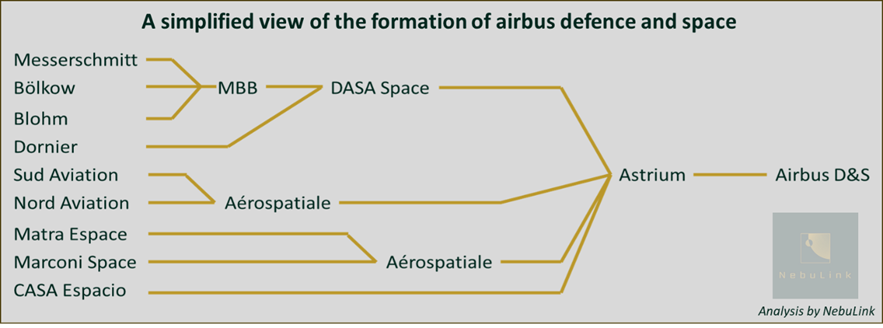
If this merger seems like a radical reshaping of Europe’s aerospace sector, it is not. Airbus, Thales, and Leonardo already work together on major projects, often in overlapping roles. Rather than smashing together three independent competitors, this move formalises what is already happening behind the scenes.
The companies have already been working together on high-profile programmes such as IRIS², the EU’s secure broadband constellation, and Galileo, the region’s answer to GPS. If anything, the merger is a belated recognition that these companies already rely on each other to keep Europe’s space infrastructure running.
Take Thales Alenia Space, where Thales owns 67 percent and Leonardo 33 percent. It is already one of Europe’s top satellite manufacturers, producing telecom, Earth observation, and navigation systems. Then there is Telespazio, another Thales-Leonardo joint venture focused on satellite services, secure communications, and ground infrastructure. Airbus already works closely with both, so the merger is not about creating monopolies.
This isn’t a shotgun wedding… it’s just making official what’s already happening.
Europe’s Airbus is No SpaceX… and That’s the Point
One of the more popular critiques of this merger is that it is Europe’s latest attempt to create its own version of SpaceX, a vertically integrated, fast-moving launch provider that can rival the United States. But that argument misunderstands both the nature of Airbus and the structure of Europe’s space industry.
SpaceX is a privately held company that integrates launch, satellite production, and broadband services under one roof. It thrives on rapid iteration, aggressive cost-cutting, and high-risk development cycles. Airbus, by contrast, is publicly traded, partially state-owned, and deeply embedded in European regulatory frameworks. Its business model is built on long-term contracts for defence, telecommunications, and scientific missions, not disruptive innovation.
This is not an attempt to build a European Starship or Starlink. The merger is about reducing redundancies, cutting procurement costs, and securing industrial scale for major European programs. Airbus has never been a serious competitor in the launch market, and its involvement in Arianespace remains secondary to its primary business of building high-reliability satellite platforms and defence technology.
What this merger can and cannot solve
Bringing together three of Europe’s largest aerospace firms will have significant effects, but not in the ways critics assume.
This merger is about efficiency. Airbus, Thales, and Leonardo already collaborate on major European projects, but overlapping responsibilities slow development. Consolidation could streamline operations, free up resources, and improve Europe’s competitiveness in the global space market. IRIS², Galileo, and Copernicus all require extensive collaboration between multiple companies, slowing development. A single, consolidated structure could reduce the bureaucratic inefficiencies that have plagued these programs for years.
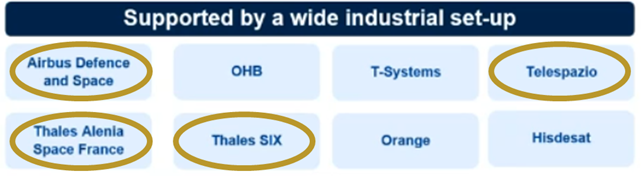
Stronger industrial coordination could also improve Europe’s global competitiveness. Airbus already builds secure military communications satellites for NATO and ESA, but European aerospace firms lack the scale of their American and Chinese counterparts. A more unified industrial base could change that, particularly in defence-related space projects where European firms struggle to match the sheer spending power of the United States, which allocated over $26 billion to space programs in 2023 alone.
But the merger will not fix deeper structural problems. European space policy remains fragmented, bogged down by competing national interests and slow-moving institutions. Merging Airbus, Thales, and Leonardo will not suddenly make ESA move faster. It will not fix Europe’s launch delays, nor will it create the conditions for a thriving commercial space sector. The merger does not change that reality.
If it collapsed tomorrow, it would not unlock venture capital for European space startups. It would not fix ESA’s painfully slow contract process, nor would it make European investors any less risk-averse. It does not force governments to rethink their reluctance to embrace a SpaceX-style model of rapid, venture-backed innovation.
The suggestion that Europe must decide between backing established industry leaders or fostering a dynamic NewSpace sector is a false choice. The reality is that Europe has already made its choice: it has spent decades propping up legacy aerospace firms while stifling commercial innovation.
At best, this consolidation makes an inefficient system slightly more efficient. At worst, it reinforces the same bureaucratic inertia that has held European aerospace back for decades.
Europe’s Real Space Bottleneck: Bureaucracy, not Mergers
The real bottleneck is not mergers, it is a system that prioritises political interests over industrial competitiveness, making it nearly impossible for companies to scale, iterate, and compete globally.
ESA has become a funding machine for legacy aerospace firms rather than a driver of innovation. Its procurement system, shaped by rigid geographic return rules, prioritises national quotas over efficiency, carving up contracts across member states instead of selecting the best providers. This approach has led to cost overruns, inefficiencies, and delays. A report led by former ECB president Mario Draghi flagged geo-return as a major barrier to Europe’s space competitiveness, arguing that it stifles innovation and limits agility in a rapidly evolving industry. In response to mounting criticism, ESA has begun exploring reforms, but its entrenched procurement model remains a structural challenge.
EUSPA, the European Union’s Agency for the Space Programme, has only added more bureaucracy. Created to centralise European space policy, it has instead become an administrative extension of the European Commission. Every major initiative it oversees, from Galileo to IRIS², is bogged down by excessive political oversight and slow-moving decision-making. It lacks the independent, market-driven approach that has allowed U.S. commercial space companies to thrive.
Unlike NASA, which has channelled billions into private-sector innovation through programs like COTS and Commercial Crew, Europe remains locked into a funding model that prioritises control over outcomes rather than fostering competition. Instead of leveraging private investment, it keeps the industry reliant on state-driven programmes, preventing the emergence of a truly competitive commercial space sector.
So, What Is Europe’s Answer to SpaceX?
If the Airbus merger is not Europe’s answer to SpaceX, then what is? The truth is, Europe is not even trying to build an equivalent. Its focus remains on institutional projects, not commercial disruption.
For years, Europe’s space policy has prioritised stability over disruption, institutional contracts over commercial competition. It has built a world-class space sector in navigation, Earth observation, and satellite manufacturing, but when it comes to launch and broadband constellations, it is falling behind.
Nowhere is this clearer than in the development of Ariane 6.
Ariane 6: A Case Study in Policy Dysfunction
Arianespace was once the world’s dominant commercial launch provider. At its peak, Ariane carried over half of the world’s commercial satellite payloads, launching high-profile missions such as the James Webb Space Telescope and Galileo navigation satellites. Today, it is struggling to stay relevant in a market transformed by SpaceX.
The Ariane 6 programme is an economic disaster. Ariane 6 was designed to be 50% cheaper than its predecessor, but inefficiencies have pushed development costs past €4 billion , yet the rocket is projected to launch only nine times per year, with nearly half of those flights already allocated to European institutional customers. By contrast, NASA’s partnership with SpaceX enabled the development of the Falcon 9 for just $390 million, with the results being clear. SpaceX launched 133 missions in 2024 alone, leveraging a mix of Starlink payloads, Pentagon contracts, and commercial customers to sustain a relentless launch cadence.
It is not just a matter of reusability. Ariane 6’s problems stem from a procurement system that actively resists efficiency. Unlike SpaceX, which has driven costs down through vertical integration and iterative design, Ariane 6’s inefficiencies stem from the same bureaucratic funding model outlined earlier… political compromise over efficiency, fragmented supply chains, and job quotas overriding technical decisions.
Nowhere is this dysfunction clearer than in the development of Ariane 6, a programme that embodies Europe’s struggle to balance political interests with industrial efficiency.
According to Politico, much of the dysfunction stems from disagreements between France and Germany. In 2014, European space ministers met in Luxembourg to define the future of Europe’s launch industry. France pushed for a clean-sheet rocket design to strengthen strategic autonomy, while Germany advocated for an incremental upgrade of Ariane 5 to reduce costs.
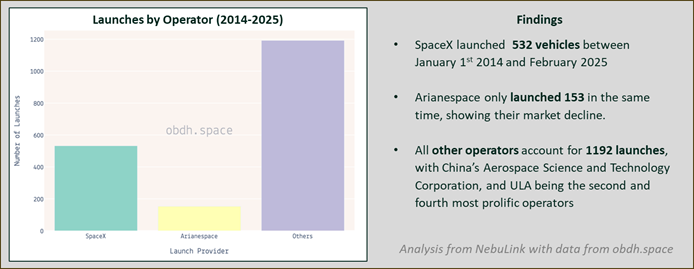
The result was a compromise that satisfied neither goal. Instead of a streamlined, commercially viable design, Ariane 6 became a patchwork project shaped by national interests rather than industrial logic. Its fragmented development process, spread across over a dozen countries, introduced inefficiencies at every stage, further eroding its ability to compete in the modern launch market.
The result is a system that closely resembles the United Launch Alliance merger in the US. Just as Lockheed and Boeing entered a forced marriage that resulted in years of inefficiency and high costs, France and Germany’s competing priorities locked Ariane 6 into a flawed, compromise-driven design process. The refusal to embrace reusability, the fragmented supply chain, and the lack of commercial incentives were all baked in from the start.
Europe’s space policymakers acknowledge these issues, but their responses have fallen short. ESA’s continued reliance on institutional contracts over commercial incentives means that even new entrants like Isar Aerospace, Rocket Factory Augsburg, and Orbex face an uphill battle.
Initiatives like the €50 million Boost! programme and the €150 million European Launcher Challenge are intended to support commercial launch startups, but together they amount to a fraction of what is needed.
In contrast, SpaceX has benefited from billions in funding over the past two decades. Unlike NASA, which has embraced commercial partnerships and channelled more than $25 billion into initiatives like COTS, Commercial Crew, CRS (Phases 1 and 2), CLPS, and HLS, Europe simply does not have an equivalent pipeline for large-scale commercial investment.
ESA’s rigid procurement model has held back not just launch, but satellite communications as well. Nowhere is this clearer than in Europe’s attempt to build a sovereign broadband constellation.
Satellite Connectivity: IRIS² vs. Starlink
IRIS² is often described as Europe’s answer to Starlink, but that comparison is misleading. Starlink is a privately funded, vertically integrated network designed for rapid deployment and global commercial dominance.
IRIS², by contrast, is a government-driven initiative focused on providing secure satellite connectivity for EU governments, military operations, and critical infrastructure. The system is designed to reduce Europe’s dependence on non-European networks, ensuring strategic autonomy in communications. While it will offer some commercial services, its primary function is to serve public-sector needs, including defence, emergency response, and secure government communications.
The EU has pledged billions of euros to IRIS², but the program is spread across multiple industrial partners and buried under layers of bureaucracy. SpaceX, which has invested over $10 billion into Starlink, controls its entire supply chain, iterates quickly, and scales based on market demand. IRIS² operates under ESA’s procurement model, where contracts are handed out to balance political interests rather than optimise efficiency.
That structural difference makes all the difference. Starlink moves fast because it can. IRIS² is slow because it has to be. If Europe wants a competitive broadband network, it needs more than a constellation. It needs a commercial strategy that values speed and flexibility over bureaucracy.
Even in areas where Europe leads, such as Earth observation and navigation, its strength comes from state-funded programs rather than commercial success. Copernicus and Galileo provide critical services, but they are not designed to be competitive business ventures. Unlike Starlink or Starship, they are conservative in scope, incremental in development, and bound by rigid procurement rules.
The Big Picture: Europe’s Path Forward
The problem is not the Airbus merger. The problem is a system that kills competition before it even starts.
Europe does not lack talent or ambition. It lacks an environment where companies can scale and succeed. Arianespace is too slow. ESA is too bureaucratic. Airbus is consolidating, not innovating. The real competition is coming from European startups developing reusable rockets, satellite constellations, and in-orbit servicing. But without serious private investment and a regulatory framework that allows them to grow, they will remain niche players in a market controlled by the United States and China.
There is no European SpaceX because there is no European Commercial Crew or COTS programme. There is no pipeline for disruptive innovation because the system was never designed to support one. Governments treat space as an industrial policy tool rather than an industry, ensuring that political deals dictate progress rather than technological advancement.
Without structural reform, Europe will not just fall behind. It will make itself irrelevant. The world is moving forward, and Europe is still debating funding models and regional job quotas.
This merger changes nothing. Europe needs competition, not consolidation.