Today, 9 April 2025, marks the beginning of one of the most ambitious satellite communications projects in history. Amazon is finally launching the first batch of operational satellites for Project Kuiper, its answer to SpaceX’s Starlink. A United Launch Alliance (ULA) Atlas V rocket is sending 27 Kuiper satellites into low Earth orbit, opening a new chapter in the race for global broadband from space.
Kuiper is designed to be a 3,236-satellite constellation, offering high-speed internet access to users across the globe through compact terminals and high-throughput space infrastructure. It has been in development for years, and today’s launch proves that Amazon can not only build its satellites, but begin putting them into orbit. However, the real story is not today’s success. It is the high-risk strategy behind the constellation’s deployment… a strategy shaped as much by competition and corporate rivalry as it is by engineering and regulation.
A Billion Pound Bet with (Almost) No Help from SpaceX
Amazon has committed billions to Kuiper. It has developed a proprietary terminal design, manufactured satellites, and secured over 90 launch contracts. It has invested in ground infrastructure, simulation tools, and spectrum licensing. But for all this investment, Amazon has also made one very clear decision: it will not launch with SpaceX.
This is not because SpaceX’s rockets are unsuitable. In fact, Falcon 9 is the most proven commercial launcher in the world, having conducted over 300 missions with a success rate few can match. It launches at a cadence that no other company has come close to replicating. Starlink exists at its current scale largely because of Falcon 9’s rapid reuse and reliable tempo. For any other company planning to deploy thousands of satellites in just over two years, partnering with SpaceX would be the logical choice.
But Amazon and Jeff Bezos are not interested in building their satellite system on top of Elon Musk’s infrastructure. Instead, they have made the calculated decision to build around SpaceX entirely, even if that means higher risk and tighter timelines.
The Rockets Are Not Ready
This decision has shaped Amazon’s entire launch manifest. And that is where the most immediate risk lies.
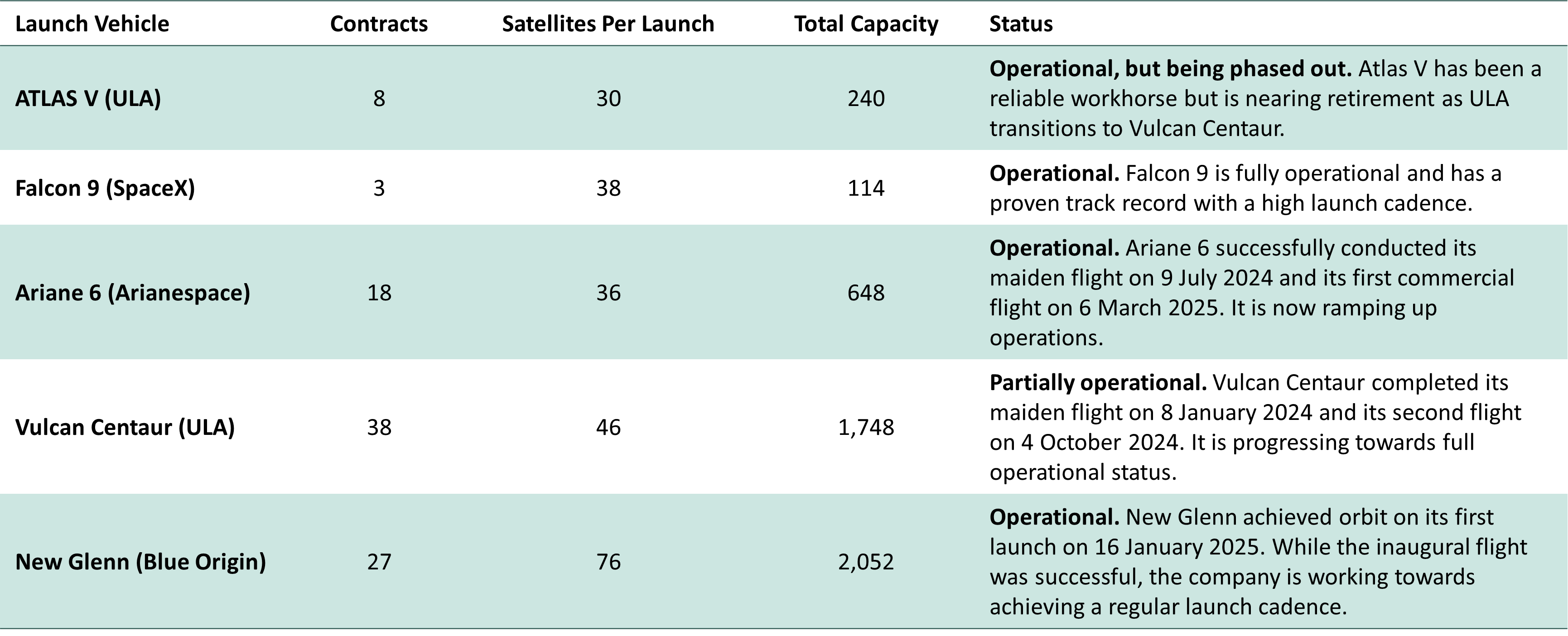
Amazon has booked over 90 launches across five rocket families. These include ULA’s Atlas V and Vulcan Centaur, Arianespace’s Ariane 6, Blue Origin’s New Glenn, and three Falcon 9 launches scheduled before the SpaceX rift hardened. Each of these vehicles comes with a very different status and set of challenges.
Atlas V is the rocket launching today. It is a workhorse with a solid record, but it is also a legacy system being retired. Amazon has secured eight of the final Atlas V flights, which together may place around 240 satellites into orbit. That is helpful, but far from sufficient, and Atlas V is not a long-term solution.
Falcon 9 was originally part of the Kuiper manifest, with three launches still on the books. These could deliver just over 100 satellites in total. But further collaboration with SpaceX has been ruled out, likely due to Bezos’s insistence on independence from his chief rival. Those launches remain the exception, not the foundation.
Ariane 6 is Europe’s new flagship launch vehicle. It completed its maiden flight in July 2024 and began commercial missions in March 2025. While it represents a critical option for Kuiper, its production rate is still uncertain. With 18 flights contracted, Amazon could potentially place over 600 satellites using Ariane 6, but only if the ramp-up proceeds smoothly, a major unknown given Europe’s cautious cadence and history of delays.
Vulcan Centaur is ULA’s next-generation vehicle, designed to replace Atlas V and support higher payloads. It flew its first mission in January 2024, but has not yet entered a regular launch rhythm. Amazon has booked 38 Vulcan launches, and expects to use it as one of its main workhorses. However, transitioning from a single test flight to dozens of operational missions in under two years is a massive leap. The risk lies not in the rocket’s design, but in its ability to scale quickly and reliably.
Then there is Blue Origin’s New Glenn. This heavy-lift rocket is expected to carry the most satellites per flight, up to 76 in some configurations, and is central to Amazon’s overall deployment plan. But New Glenn has not flown. Its first launch is tentatively targeted for late 2025. That gives Amazon very little time to complete the 27 launches it has booked with Blue Origin, and any further delay could ripple across the entire deployment timeline. Ironically, New Glenn is a Bezos-owned product, making Amazon’s reliance on it less about diversification and more about keeping things in the family.
Taken together, these vehicles could theoretically get Kuiper to its target. But that outcome depends on all of them working as expected, ramping up immediately, and avoiding any further delays. That is a very tall order for any space programme, especially one with a regulatory clock ticking.
The Spectrum Deadline Is Real
Amazon has until 30 July 2026 to deploy 1,618 satellites, half of its planned constellation, or risk losing its spectrum licence. This deadline is not optional. It is a binding requirement from the US Federal Communications Commission and is designed to prevent companies from warehousing orbital resources.
To meet this, Amazon needs a rapid cadence of launches across multiple vehicles, starting now. That means moving from today’s 27 satellites to hundreds, and from hundreds to thousands, with very little margin for error. Any delay in production, integration, or vehicle availability could push Kuiper behind schedule. The difference between success and regulatory failure may come down to a few launches slipping into 2027.
Even if Amazon’s terminals are ready, and by most accounts, they are, the system will not function until enough of the constellation is in orbit. This is not just about manufacturing hardware. It is about getting it into space fast enough to meet the rules.
More Than Just a Commercial Project
Kuiper is not merely a product. It is a geopolitical asset. Starlink’s role in Ukraine has shown how powerful space-based communications can be in times of crisis. It has also raised alarm. Governments are increasingly wary of relying on a single private company, particularly one controlled by an unpredictable figure with global influence.
Europe has responded with IRIS². The United States is pursuing military-specific constellations. Countries across Asia and the Middle East are exploring dual-use communications infrastructure. In this context, Kuiper should be a welcome alternative, a second source with global reach, backed by one of the most powerful tech firms on Earth.
But Amazon must first prove that it can deliver at scale. If the launch vehicles fail to materialise or timelines slip, Kuiper will remain a future option rather than a functioning system. The geopolitical desire for alternatives will remain unmet.
A Launch Is Not a Deployment
Today’s launch is a success. It shows that Kuiper is more than a white paper or prototype. It proves that Amazon can build and fly real hardware. That in itself is an achievement.
But the true test begins now.
Over the next year and a bit, Amazon must deploy more than 1,500 satellites, relying on launch vehicles that have never supported such a tempo. It must manage production, integration, ground operations, licensing, and international coordination, all while refusing to use the most available launch provider in the world.
This is not just a technical challenge. It is a strategic experiment in whether a constellation can be deployed at scale without relying on the existing commercial infrastructure. If it succeeds, Amazon will have built a communications platform that rivals Starlink on its own terms. If it fails, it will not be for lack of funding or engineering. It will be because a strategic choice, to avoid SpaceX at all costs, proved too risky.
Kuiper is now in orbit. But its future will be decided by every launch that follows, and whether Amazon’s billion pound bet can stay on schedule.