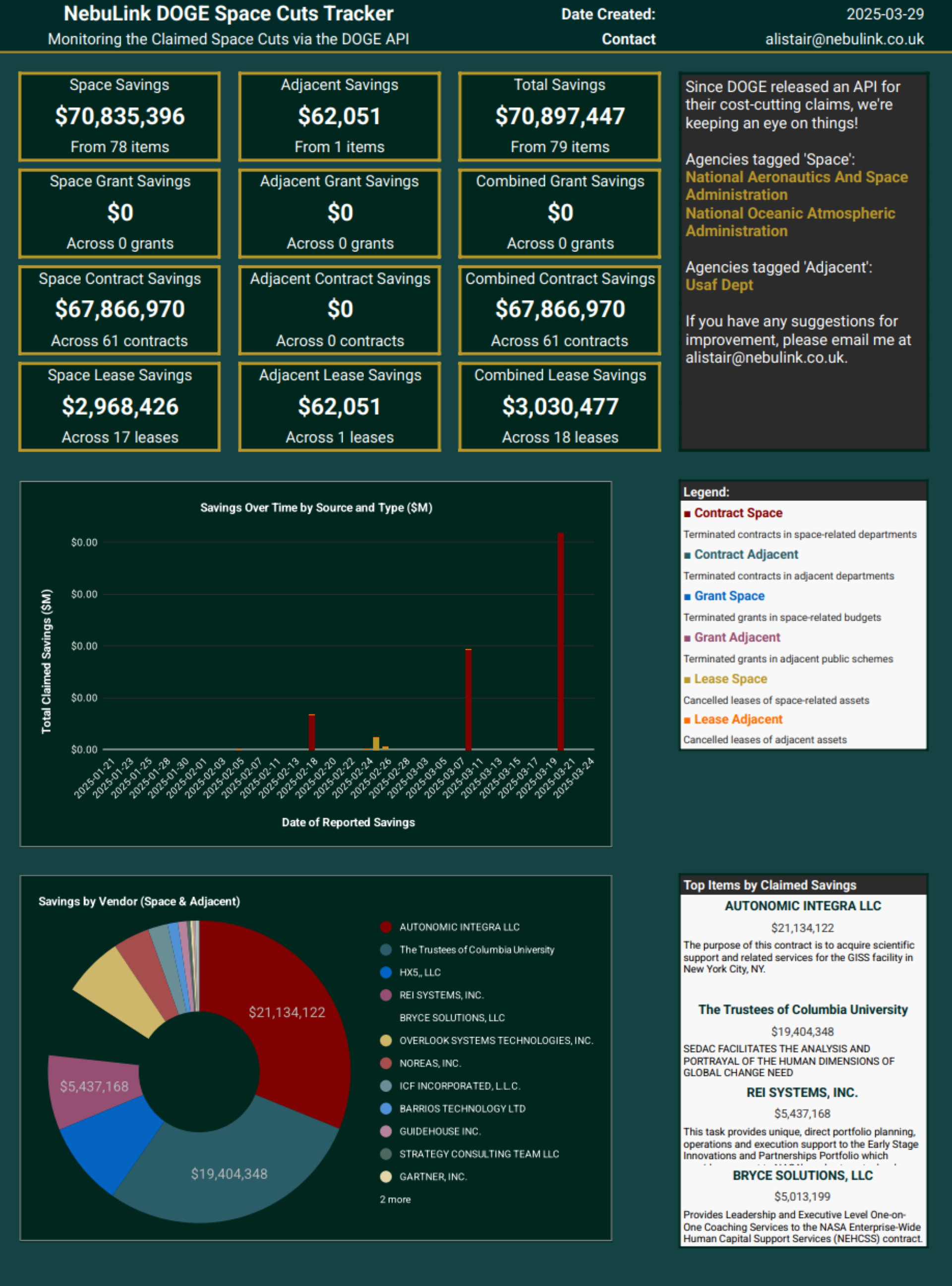
The US government says it is saving money. The Department of Government Efficiency’s “transparent” system now lists over $70 million in claimed savings from deleted space-related contracts and leases. But a closer look reveals something stranger: nearly half of these savings entries report zero dollars saved.
From expensive research awards to recurring training programmes, dozens of contracts were terminated or modified without any financial savings attached. Whether these are administrative cleanups, strategic pivots, or just data artefacts, the result is the same: the public is told savings are happening, but the numbers often do not show it.
This article shines a light on where the cuts are real. We unpack the 46 entries where money was actually saved, identify who lost funding, and trace what the federal space budget is quietly stepping away from.
At NebuLink, we are increasingly concerned that these so-called “space savings” are passing without proper scrutiny. Despite millions being flagged for cancellation, there has been little to no public reporting on what is actually being cut, or what it means for science, infrastructure, and long-term strategy. Never mind that in many cases, it is unclear whether these cuts are even legally permitted under current appropriations.
This dashboard is our attempt to shine a light on that gap. It is also part of an ongoing exercise to improve our own API monitoring and JavaScript-based dashboarding skills, while exploring how government transparency data can be turned into something more accessible.
This is the first edition of the DOGE Tracker. We will continue to track what changes, who gets the axe, and whether claimed savings are rising, falling, or simply changing form. Each update will compare the latest deletions and savings against the previous one to keep a steady eye on how DOGE is evolving.
The NebuLink DOGE Tracker
Research & Development – $49 million
This category saw the most substantial cuts:
- $21.1M – Scientific support for NASA’s Goddard Institute for Space Studies (GISS) provided by Autonomic Integra LLC
- $19.4M – Termination of the SEDAC programme run by Columbia University
- $5.4M – Early-stage innovation portfolio support provided by REI Systems
Additional prototype testing and engineering work by HX5 LLC was also cut:
- $1.5M – Superconducting motor components and test devices
- $0.8M – Prototype motors for dusty and cold environments
- $0.15M – Advanced seal development
Other reductions:
- $261K – Strategy support for the Planetary Sciences Division delivered by Barrios Technology
- $194K – Learning and development services from Gartner Inc.
Lease Termination – $3.2 million
The National Oceanic and Atmospheric Administration (NOAA) terminated 14 property leases. Highlights include:
- $1.45M – Lease termination in Key Largo, FL
- $488K – Lease termination in Idaho Falls, ID
- $225K – Lease termination in Port Angeles, WA
- $198K – Lease termination in Narragansett Pier, RI
All cuts were associated with NOAA, and most entries cited only “termination via Mass Mod”.
Strategic Support & Consulting – $8.9 million
NASA cut a range of external contracts:
- $2.6M – Environmental consulting by NOREAS Inc.
- $1.9M – Hardware test support for turbofan components from HX5 LLC
- $1.8M – Electric drive system support and communications by HX5 LLC
- $1.4M – Coordination services by ICF Incorporated
- $640K – Internal control and fraud risk management provided by Guidehouse Inc.
- $155K – Stakeholder engagement support from HydroGeoLogic Inc.
Multiple smaller strategic support tasks were cancelled with Barrios Technology.
Workforce & Training – $5.3 million saved
Human capital and diversity spending cuts included:
- $5.0M – Executive coaching contract with Bryce Solutions LLC under NASA’s NEHCSS framework
- $248K – Termination of supervisory leadership training support from Strategy Consulting Team LLC
- $33K – End of NASA’s partnership with the Society of Women Engineers
Policy & Administration – $4.4 million saved
- $4.4M – Policy and strategy advisory contract with Overlook Systems Technologies Inc., focused on space and PNT policy
Software & Tools – $167,000 saved
NASA cancelled several software support contracts:
- $46K – Novice software contract with EMP Consultants LLC
- $38K – Digimat software support from ImmixTechnology Inc.
- $34K – Genesys software support from Keysight Technologies Inc.
- $10K – ADS software tools, vendor not specified but classified under software cuts
Infrastructure & Equipment – $96,700 saved
- $96.7K – Storage and parts removal for DC-8 and SOFIA aircraft contracted to Business Class Aviation Inc.
Columbia Cluster: Three linked cuts
NebuLink’s dashboard reveals something striking. Over $40 million in claimed savings target research programmes based at or affiliated with Columbia University:
- $19.4M cut from the SEDAC programme, led by Columbia and focused on global change and societal impacts
- $21.1M slashed from scientific support to GISS, delivered by Autonomic Integra but housed in Columbia’s Armstrong Hall
- $0 from the cancellation of a 3D tissue longevity research contract, also linked to Columbia
These are the largest clustered cuts in the DOGE data. While listed under space spending, each of these programmes touches on climate science, public health, and long-term risk modelling. In other words, they sit close to politically contested ground.
The numbers suggest something deeper than routine savings. This looks like targeted pressure on Columbia University, and raises a harder question: is a premier research institution now in the crosshairs of a government looking to reshape the scientific agenda?
Conclusion
What we have uncovered is just the beginning. The DOGE system offers a glimpse into how federal agencies report “efficiency”, but it raises more questions than it answers. Nearly half the listed savings entries appear to save no money at all.
By tracking these deletions in detail, NebuLink aims to bring more transparency to a process that remains opaque. Whether it is a quiet retreat from research, the offloading of real estate, or the silent end of strategic partnerships, these changes matter. They deserve more scrutiny than a single row in a spreadsheet.
We will continue to monitor DOGE’s space-related deletions and publish updates as new cuts appear and patterns emerge. If you work in this space, follow the dashboard, stay tuned, and get in touch if you see something we should be tracking.
Because if no one is watching, it becomes far too easy to call it savings.