This analysis builds upon insights from New estimates for the UK’s regional space workforce, a regional workforce analysis conducted by the Space Skills Alliance.
The UK’s space sector is often heralded as a global success story, showcasing innovation, growth, and leadership in areas like small satellite manufacturing, launch services, and space research. Scotland, in particular, has gained recognition as a hub for satellite manufacturing and space data analytics, with Glasgow producing more small satellites than any other city in Europe. The country’s regional clusters play a pivotal role in driving this success, supporting both economic growth and technological advancements.
However, recent data calls into question how accurately this growth is measured. The inclusion of Direct-to-Home (DTH) broadcasting roles has significantly inflated workforce numbers in certain regions. This methodology risks obscuring the true distribution and concentration of the UK’s space workforce, making it difficult to assess where the sector is genuinely thriving versus where it is overstated. After all, when we talk about ‘the Scottish Space Industry’, we aren’t referring to opening of a SkyTV customer service hub are we?
As the Space Skills Alliance notes, the data from the UK Space Agency’s Size and Health Report is used by the government to inform policy, by investors to guide funding, and by companies to shape international strategies. Understanding the nuances behind these regional disparities is critical for ensuring the UK space industry achieves balanced growth.
Space Workforce: Winners and Losers Revealed
The chart below illustrates the distribution of the UK’s space workforce (excluding DTH roles) alongside population proportions for each region.
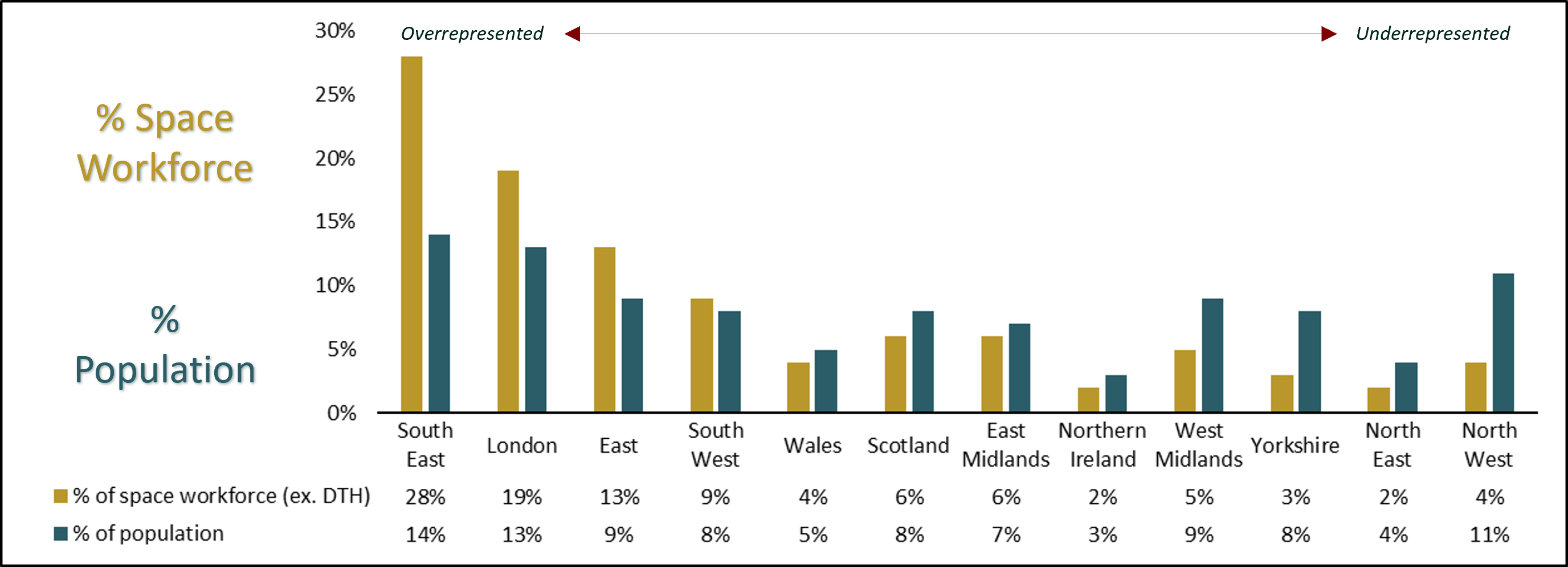
The chart paints a clear picture of the UK’s space workforce distribution, showing both successes and gaps as we move across the regions from most overrepresented to least.
- The South East emerges as the clear winner. Despite having just 14% of the UK population, it commands an impressive 28% of the space workforce. This dominance is largely driven by the Harwell Space Cluster, a thriving hub for innovation with over 100 organizations involved in satellite manufacturing, research, and Earth observation.
- London comes next. While its share drops significantly after excluding DTH roles (from 33% to 19%), it remains overrepresented compared to its 13% population share. Major companies like Inmarsat and OneWeb keep London a vital part of the UK space ecosystem, particularly in satellite communications.
- In the East of England, the workforce share climbs to 13%, outpacing its 9% population proportion. This reflects the contributions of key hubs like Stevenage and Cambridge, home to Airbus Defence and Space and innovative space tech companies.
- The South West also holds its ground, with a workforce share of 9% closely aligned to its 8% population share. This success is fueled by Spaceport Cornwall and Goonhilly Earth Station, which are driving satellite communications and horizontal launch capabilities.
- Scotland tells a more complex story. Its workforce share drops from 12% to 6% after excluding DTH roles, revealing its reliance on satellite broadcasting. Despite this, Glasgow and Edinburgh continue to excel in small satellite manufacturing and data analytics, keeping Scotland a key player in the space industry.
- The East Midlands and Wales are notable as emerging hubs. Both have workforce shares close to their population proportions (6% vs. 7% for the East Midlands and 4% vs. 5% for Wales), supported by growing innovation in places like Leicester and Cardiff, with Space Forge leading the charge in Wales.
- Moving further, the West Midlands, Yorkshire, and the North East show significant underrepresentation, with workforce shares far below their population proportions. For instance, the North East has just 2% of the workforce while accounting for 4% of the population.
- Finally, the North West stands out for its stark disparity. Despite housing 11% of the population, it contributes only 4% of the workforce, highlighting a clear gap in space industry development, which is obvious to anyone working within the industry.
How to Fix This?
To address disparities and foster balanced growth, these targeted policy measures can help unlock the full potential of the UK’s space sector.
1. Refine Workforce Metrics for Better Policy Planning
- Why: The inclusion of DTH broadcasting roles distorts workforce data, masking the real scale of regional space industries.
- Action: Redefine workforce measurement methodologies to exclude non-core roles, enabling accurate policymaking and investment.
2. Invest in Underrepresented Regions
- Why: Regions like the North West and North East are significantly underrepresented compared to their population shares.
- Action: Launch dedicated regional space development programs with grants, tax incentives, and infrastructure funding, ideally through existing mechanisms and organisations (e.g., the Northern Space Alliance, the North West Space Cluster).
3. Expand Regional Education and Training Opportunities
- Why: A lack of specialized training limits local talent pipelines in underrepresented regions.
- Action: Partner with universities and colleges to develop space-related courses and apprenticeships tailored to industry needs.
4. Support the Growth of Emerging Hubs
- Why: Regions like Wales and the East Midlands show promise but need sustained support to compete.
- Action: Build on local successes, such as Cardiff’s Space Forge, through increased funding and international collaboration.
5. Encourage Inter-Regional Collaboration
- Why: Established hubs like Harwell could act as knowledge-sharing partners for emerging regions.
- Action: Create further incentive schemes for partnerships between established and developing clusters, ensuring that supported companies can easily navigate and transition across clusters.
Conclusion
A thriving UK space sector depends on the equitable growth of its regional workforce and infrastructure. By addressing data inaccuracies, fostering collaboration, and investing in education, underrepresented regions can become integral players in the space industry. These policy measures not only support balanced growth but also strengthen the UK’s global leadership in space innovation.